


AI isn't just taking over our minds, it's grabbing our wallets too! Let's dive into where the cash is flowing, and find out which AI focus areas are getting the most love from investors around the world.
AI investments can reveal a lot about the current focus and future expectations of the industry. Who’s getting the funding? Which regions are leading the charge? And most importantly, which areas of AI are hot and which are cooling off? Let's explore three tables that explain AI investment trends by focus area and geographic area between 2017 and 2023.
Private Investment in AI by Focus Area, 2022 vs. 2023
Looking at the changes in AI investments from 2022 to 2023, we can see that the biggest jump occurred in AI infrastructure, research, and governance, which attracted a whopping $18.3 billion in 2023. This shows a significant interest in building the core foundations of AI, from the frameworks and research to the governance mechanisms needed to keep things on track. Think of it as building the world’s fanciest AI treehouse—you need a strong foundation if you want to hang out with the cool tech.
Thanks for reading Chat Over AI! Subscribe for free to receive new posts and support my work.
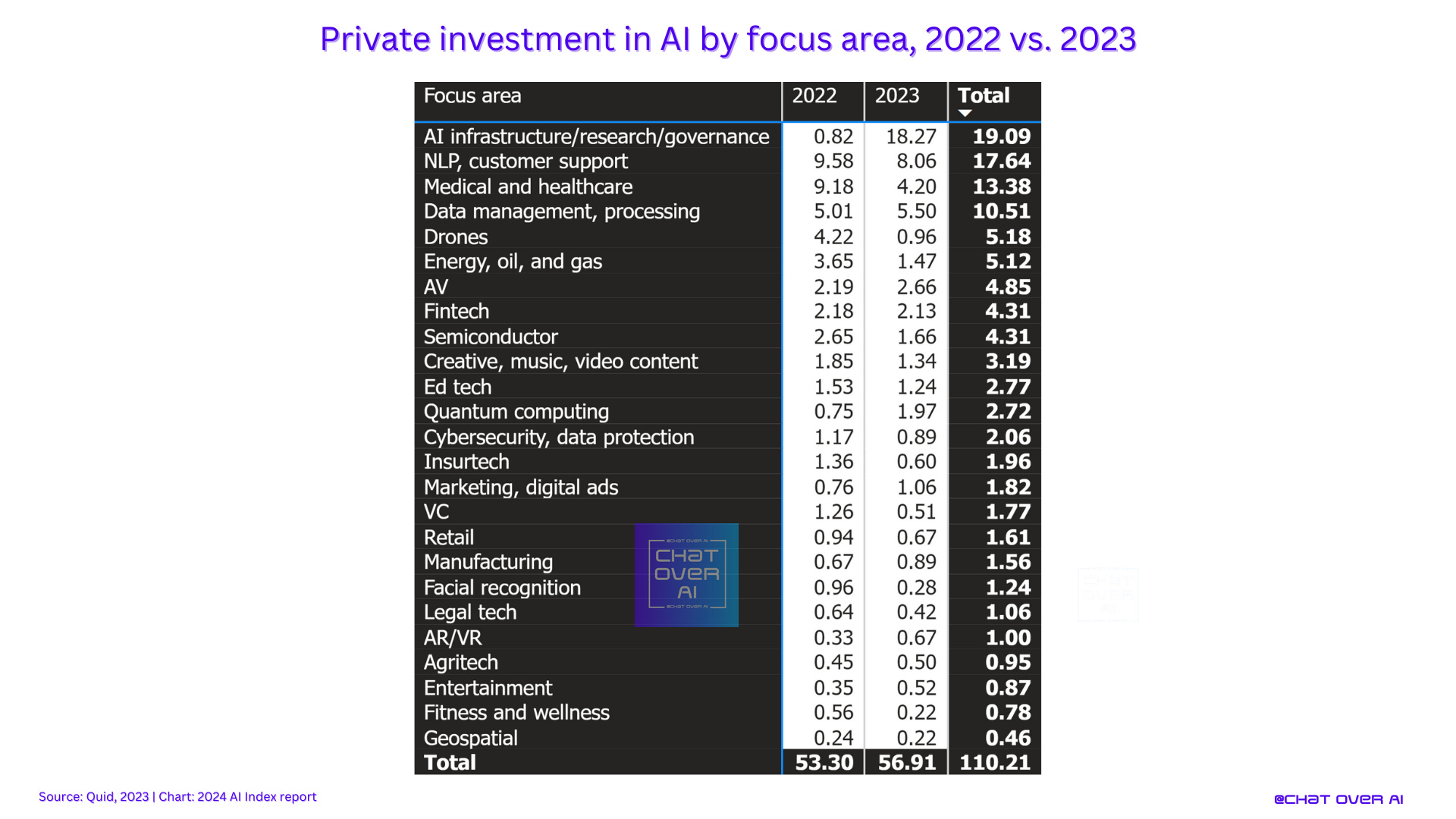
On the other hand, NLP (natural language processing) and customer support were still popular, drawing $8.1 billion, even though that’s a dip from the previous year. Clearly, companies are still betting big on chatbots and AI-powered customer experiences. After all, nothing says "the future is here" quite like arguing with a virtual assistant that doesn’t understand what "speak to a human" means.
Interestingly, data management and processing also grew to $5.5 billion, highlighting the growing need to deal with the ever-expanding deluge of data these AI systems are chewing on. If AI is the new engine of innovation, data is undoubtedly its fuel. And apparently, 2023 was the year we decided to supercharge that engine with rocket fuel.
Focus areas like healthcare, fintech, and semiconductors saw drops compared to the previous year, reflecting changing investor sentiment and perhaps the saturation in those fields. But don't write them off just yet—these are still big players in the AI game, just maybe taking a quick nap before their next big move.
Trends in Private AI Investment by Focus Area, 2017–23
Zooming out a bit, let's take a look at AI investments from 2017 to 2023. The NLP, customer support focus area has led the pack with a cumulative total of $48.8 billion over the years. Healthcare is also a major focus, pulling in $33.8 billion during the same period—proof that the healthcare sector is serious about integrating AI into diagnostics, treatments, and administration. Who wouldn’t want a chatbot diagnosing their next sore throat, right?
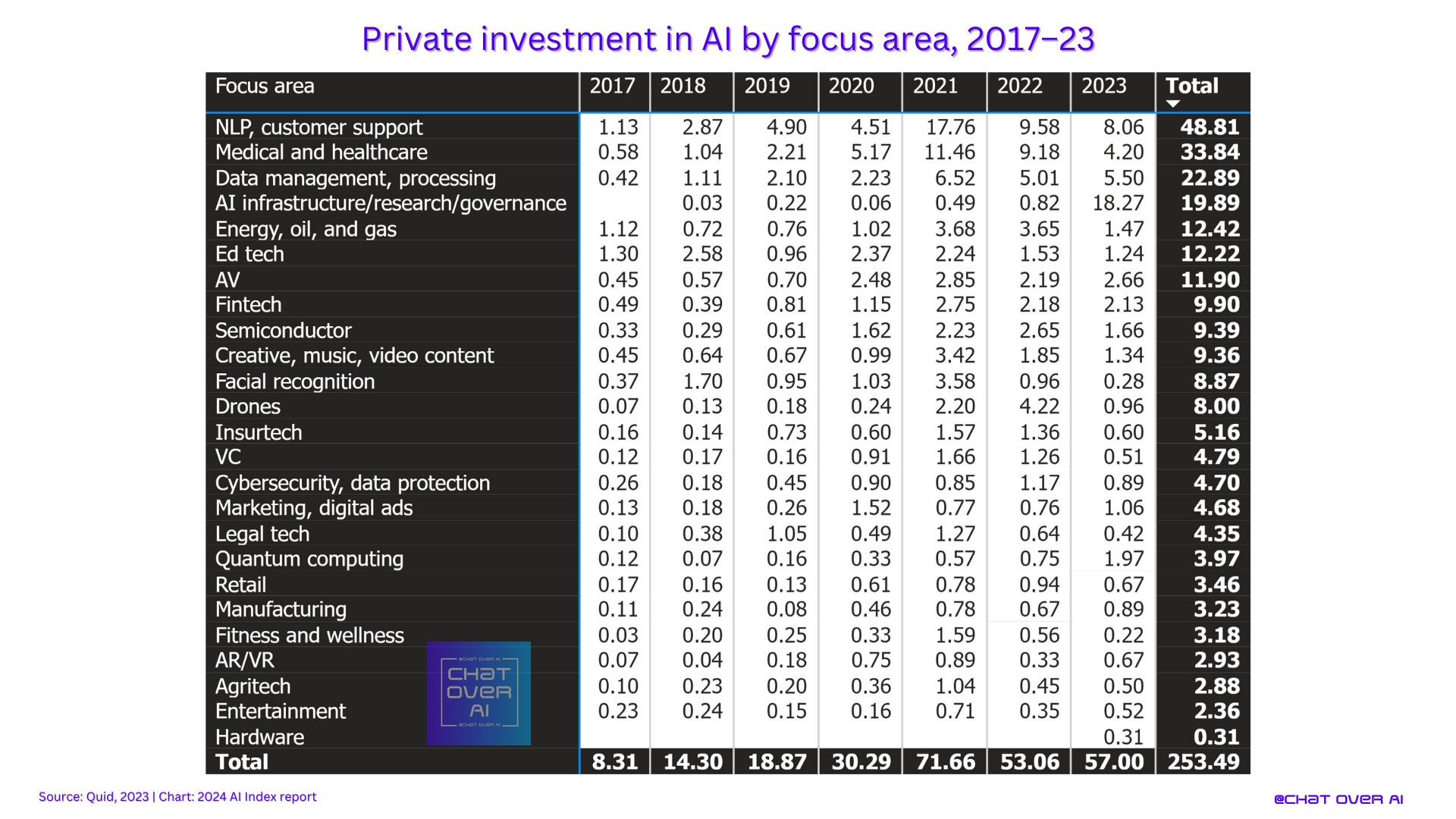
A striking trend here is the meteoric rise in AI infrastructure, research, and governance from 2022 to 2023, with investments jumping from less than a billion dollars to over $18 billion. Clearly, investors are now more interested in ensuring AI's scalability, robustness, and ethical use—a good sign given all the ethical dilemmas and regulatory challenges AI is stirring up! Maybe they finally realized that letting AI run wild without a leash might end up in a Hollywood-style "robots take over the world" scenario.
Some of the more niche areas, like facial recognition and AR/VR, have seen fluctuating levels of funding. After peaking in 2021, facial recognition investments took a steep drop, likely due to increasing concerns over privacy and regulations. Apparently, people aren't too keen on having their faces recognized at every street corner—who knew? Meanwhile, AR/VR—while never a huge part of the AI pie—has shown a modest recovery, as excitement around the metaverse concept simmers but still lingers. Let’s just say, the idea of attending virtual meetings in a floating office is still cool... for some people.
Investment Differences Across Geographic Areas: U.S., China, and Europe (2017–23)
The final table looks at private investment across different regions for various AI focus areas between 2017 and 2023. No surprises here—the United States continues to dominate almost every category. The significant surge in AI infrastructure and governance was led mainly by U.S.-based investments, showing that the country isn’t just interested in AI applications, but also in the foundational research and infrastructure required to lead globally. They’re not just playing with fancy AI toys—they’re building the entire toy factory.
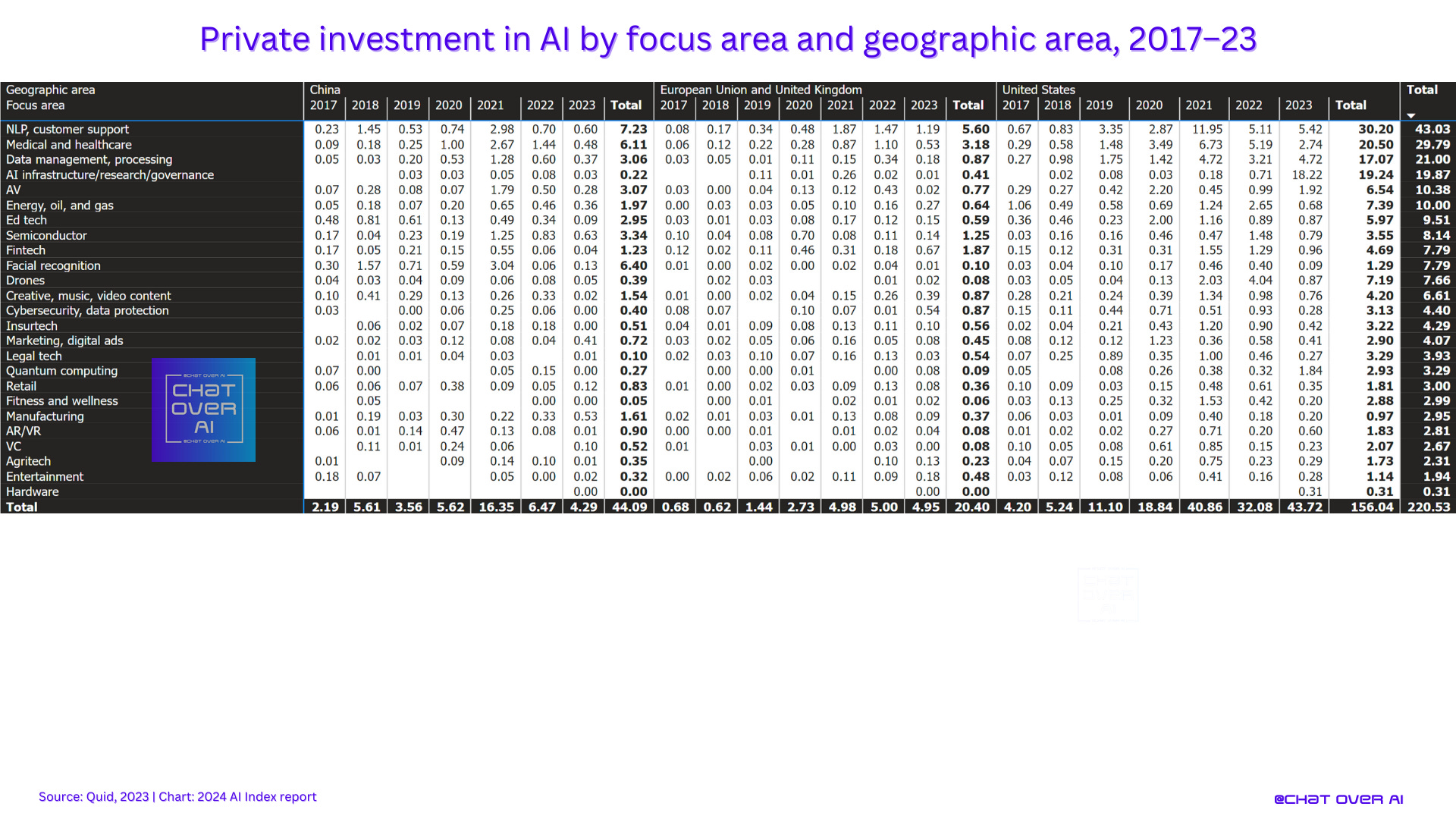
However, China isn’t far behind, particularly in areas like semiconductors and facial recognition. In 2023, China invested $630 million in semiconductors—nearly on par with the $790 million invested by the U.S. This trend is a clear indicator of China’s strategic interest in reducing dependency on foreign semiconductor technology. Plus, they’ve got to keep those futuristic surveillance cameras rolling, right?
The European Union and United Kingdom lag behind in most categories, but they still contribute significantly to research and development in AI. Investments here were notably focused on NLP and healthcare, suggesting a strong push towards AI applications that directly impact citizens’ lives. It’s almost like Europe is saying, “Forget about the killer robots—let’s make sure AI is actually useful to people!”
Interestingly, facial recognition is an area where China is significantly outpacing the U.S., with $130 million invested in 2023, compared to $90 million in the U.S. This highlights China’s ongoing interest in surveillance technologies, despite the growing scrutiny these technologies face globally. Nothing says "we’re watching you" quite like out-investing everyone else in facial recognition tech.
What Do These Trends Mean for AI's Future?
So, what does all of this mean for the future of AI? Investors are clearly looking at long-term value in AI infrastructure and governance—this foundational work is crucial if we want AI to become more integrated into our daily lives in a sustainable and safe way. NLP, healthcare, and data management are still big winners, indicating that we're not done yet when it comes to making our digital assistants, chatbots, and AI doctors smarter. Imagine a future where your doctor is a chatbot that’s also your therapist and maybe even your personal DJ—AI is moving fast!
It’s also fascinating to see how geographic differences play out, with the U.S. leading in most areas, but China holding its own in semiconductors and facial recognition. Europe might be behind in sheer numbers, but it's clearly focusing on areas that affect the day-to-day lives of its citizens. After all, what’s the point of world domination if your citizens can’t get decent healthcare or customer support?
All these trends point to one thing: AI isn’t slowing down. It’s getting more focused, more ethical (hopefully), and more integrated. Whether it's helping you find customer support or developing the next-generation chips that power these AI systems, one thing is for sure—AI investment is a race to build the future, and everyone wants a piece of it.
Thanks for reading Chat Over AI! Subscribe for free to receive new posts and support my work.