


The story of America's violent crime rate over the last few decades is one filled with unexpected turns, political influences, and societal changes. Understanding these trends helps us make sense of where we have been and where we might be headed.
A Crime Story with Ups and Downs
In the past 40 years, the United States’ violent crime rate has been on a wild roller coaster ride—full of dramatic climbs and exhilarating drops. Depending on the year and the president in charge, Americans have either feared for their lives or felt a sense of relative safety while watching late-night TV. Let’s break down the numbers and, in true Tarantino fashion, try to make sense of the chaos.
The Reagan-Bush Era: The Crime Wave Builds
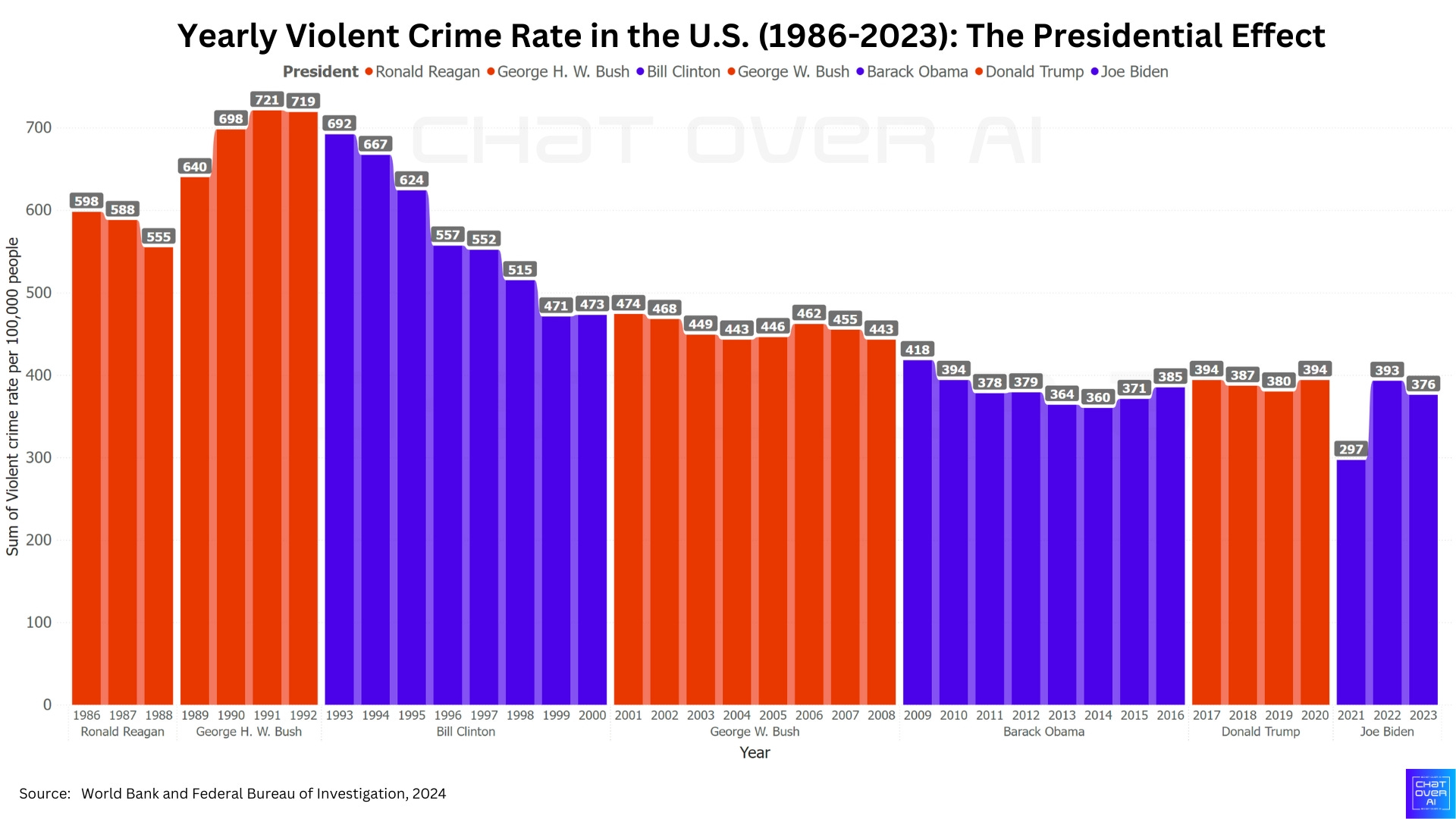
Kicking off in the 1980s, under President Ronald Reagan, the violent crime rate started at a somewhat reasonable 598 crimes per 100,000 people in 1986. The rate, however, saw a steady climb, possibly coinciding with the 1980s "War on Drugs," economic inequality, urban decay, and the rise of crack cocaine use, which contributed to increased crime and strained law enforcement resources. The rate, however, saw a steady climb, possibly coinciding with the 1980s “War on Drugs” and the glitzy-yet-grim vibe of “Miami Vice.” By the time George H.W. Bush took over in 1989, the rate had ballooned to 640—a prelude to what would become a peak for violent crime in the early 90s.
The Clinton Spike: America’s Crime High (And Not the Fun Kind)
If you remember the 1990s, you might recall the fond nostalgia of grunge, flannel, and... violent crime. Under Bill Clinton’s presidency, the crime rate soared to an all-time high of 721 in 1993. It’s like America decided to follow the mantra “Go big or go home,” and decided to go all in on crime. Experts say that factors like a rise in urban gang activity and economic struggles contributed to this crime boom.
Bill Clinton wasn’t just the president who played the saxophone on “The Arsenio Hall Show,” he also oversaw one of the most significant crime control measures in U.S. history: the 1994 Crime Bill. This bill was controversial, as while it is credited by some for starting the decline in violent crime rates, others argue that it contributed to the mass incarceration problem, disproportionately affecting minority communities. This controversial piece of legislation is credited by some for starting the decline in violent crime rates, although others argue it contributed to the mass incarceration problem.
George W. Bush: A Gradual Decline
Crime rates began to trend downward during George W. Bush’s time in office. By the time we reached 2008, the rate dropped to 455 per 100,000 people—a considerable improvement from the Clinton years. This decline can be attributed to several factors, including increased funding for local law enforcement, the introduction of community policing initiatives, and the overall economic stability during Bush's presidency. Perhaps Americans were too distracted by the rise of reality TV (thanks, “Survivor” and “American Idol”) to focus on more nefarious activities. Or maybe, just maybe, the country was seeing the benefits of better policing strategies and economic recovery.
The Obama Era: A Continuing Fall
Under Barack Obama, the U.S. continued to see a decline in violent crime, reaching a rate of 360 per 100,000 by 2014. This decline was partly attributed to initiatives like the 'My Brother's Keeper' program, which aimed to address opportunity gaps faced by young men of color, and efforts to improve police-community relations. Obama once said, "Change will not come if we wait for some other person or some other time." Well, crime did change, and for the better. Improved economic conditions, community policing efforts, and changes in demographics all helped crime to reach its lowest point since the 1960s. By 2016, it seemed America was on a hopeful path—at least until the next twist in the story.
Trump: A Brief Uptick
The Trump years saw a slight reversal in crime rate trends, partly due to social unrest, the opioid crisis, and the rollback of some policing reforms that had been implemented during previous administrations. Beginning in 2017, the violent crime rate plateaued and even ticked up a bit, hitting 394 per 100,000 in both 2017 and 2020. While Trump often painted a picture of “American Carnage,” the reality was less dramatic than the rhetoric. Experts point out that political polarization, economic instability, and social tensions likely played a role in this stagnation. Ironically, as crime rates started creeping back up, streaming platforms started flooding us with true crime documentaries—a morbid coincidence, perhaps?
Biden: Trying to Flatten the Curve
As Joe Biden took the wheel, the crime rate showed some signs of stabilizing. By 2021, there was a noticeable dip to 297, but it was followed by an increase to 393 in 2022. This fluctuation could be attributed to the lingering effects of the COVID-19 pandemic, economic instability, and challenges in law enforcement recruitment and retention. It’s like America’s crime rate decided to dance to the beat of a mixed playlist—some calm jazz followed by an unexpected drop of heavy metal. Biden has echoed the need for police reform and community safety, balancing the nation’s cry for reduced crime with an equally passionate call for social justice. Whether he can orchestrate a significant long-term decline remains to be seen.
So, What Gives?
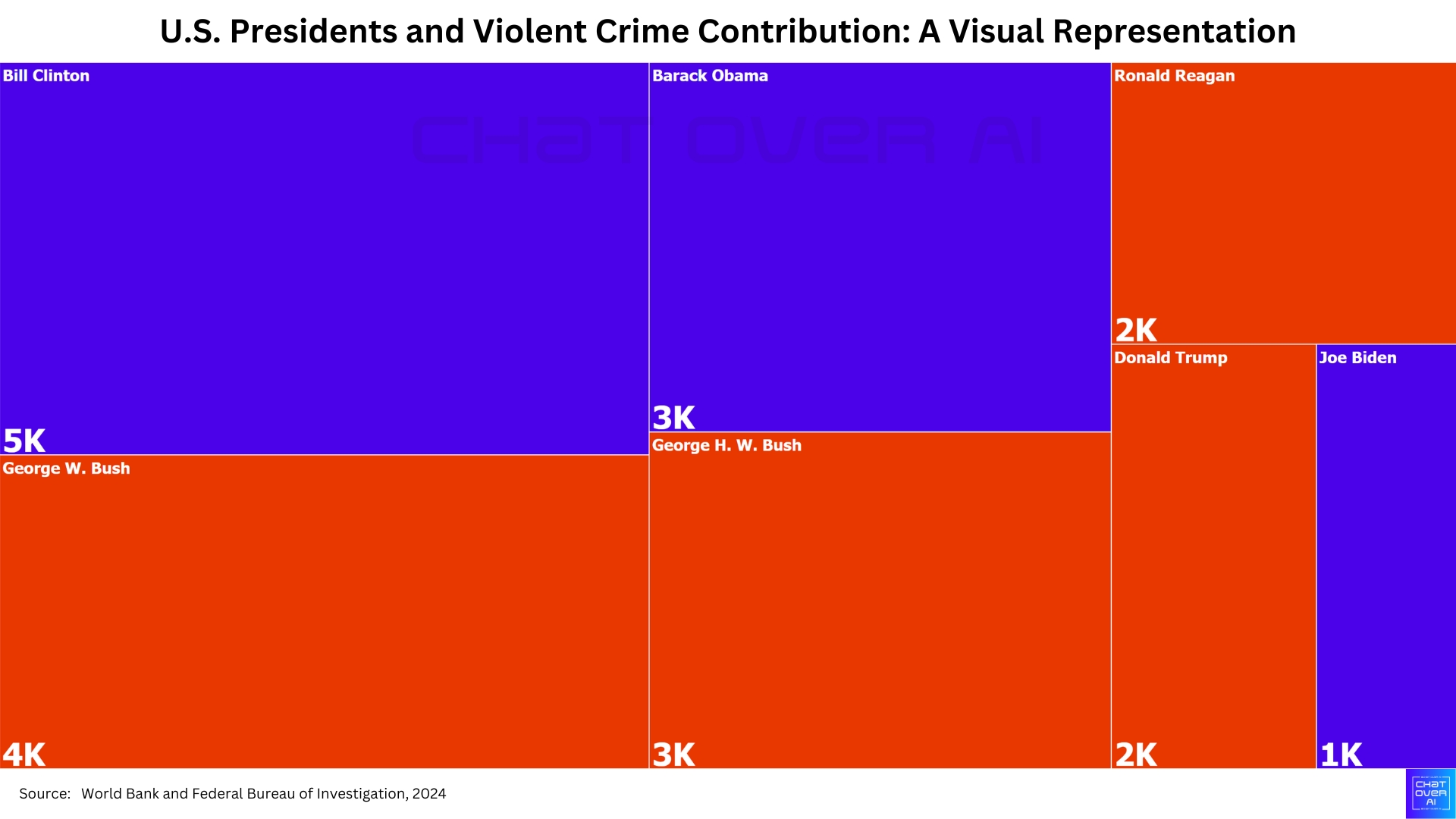
It’s tempting to attribute crime trends to whoever happens to be living in the White House, but experts suggest that crime rates are influenced by a complex mix of factors—economic conditions, policing strategies, societal shifts, and even cultural trends. According to sociologist James Alan Fox, “There’s no magic bullet for crime reduction. It’s a combination of carrots and sticks, economic stability, effective policing, and good community relations.” Criminologist John Pfaff, however, argues that focusing on reducing incarceration rates and investing in mental health services could be key components to sustainable crime reduction.
Conclusion: Lessons from the Crime Roller Coaster
What can we take away from the ups and downs of America’s violent crime rate? Well, one thing’s for sure—crime is far from simple. It’s as unpredictable as a season finale of “Breaking Bad,” and equally complicated. Crime, much like life, doesn’t follow a linear path, and it requires more than slogans and speeches to solve.
Perhaps the next time we want to gauge how safe our neighborhoods are, we might consider the intricate blend of policies, economy, community engagement, and yes, maybe even how many streaming shows about crime we binge-watch. Ultimately, it's up to each of us to support community initiatives, advocate for effective policies, and foster environments where safety and opportunity go hand in hand.
In the end, maybe we all just need fewer guns and more good Netflix shows—or perhaps fewer crime shows on Netflix?
If you have thoughts or theories on what could drive down America’s violent crime rate, leave them below. Just remember—keep it civil, and please, no crime.
Charts come from the Federal Bureau of Investigation and World Bank, and are updated as of Sept. 2024.