


Robots! Just the word makes you think of those sci-fi movies where humanity is just one miscalculated algorithm away from being vaporized by metallic overlords. In reality? Our robot friends are much more interested in assembling cars, flipping burgers, or helping you not trip over your own clutter (thanks, Roomba). Let’s dive into how robots are making waves in our world—and why you shouldn't panic just yet. Trust me, they’re still too busy vacuuming to organize a revolt.
The Rise of Robots: Less Terminator, More Friendly Butler
First off, let’s clear something up: robots are not coming to replace you tomorrow. Unless your job involves endlessly picking up objects from conveyor belts or being extremely good at holding heavy things for hours without complaining—in that case, maybe reconsider a career in interpretive dance or art curation. The robots of today aren’t here to enslave us; they’re more like that super helpful co-worker who does all the tasks nobody wants to do, like calculating taxes or pretending to care about process optimization.
Thanks for reading Chat Over AI! Subscribe for free to receive new posts and support my work.
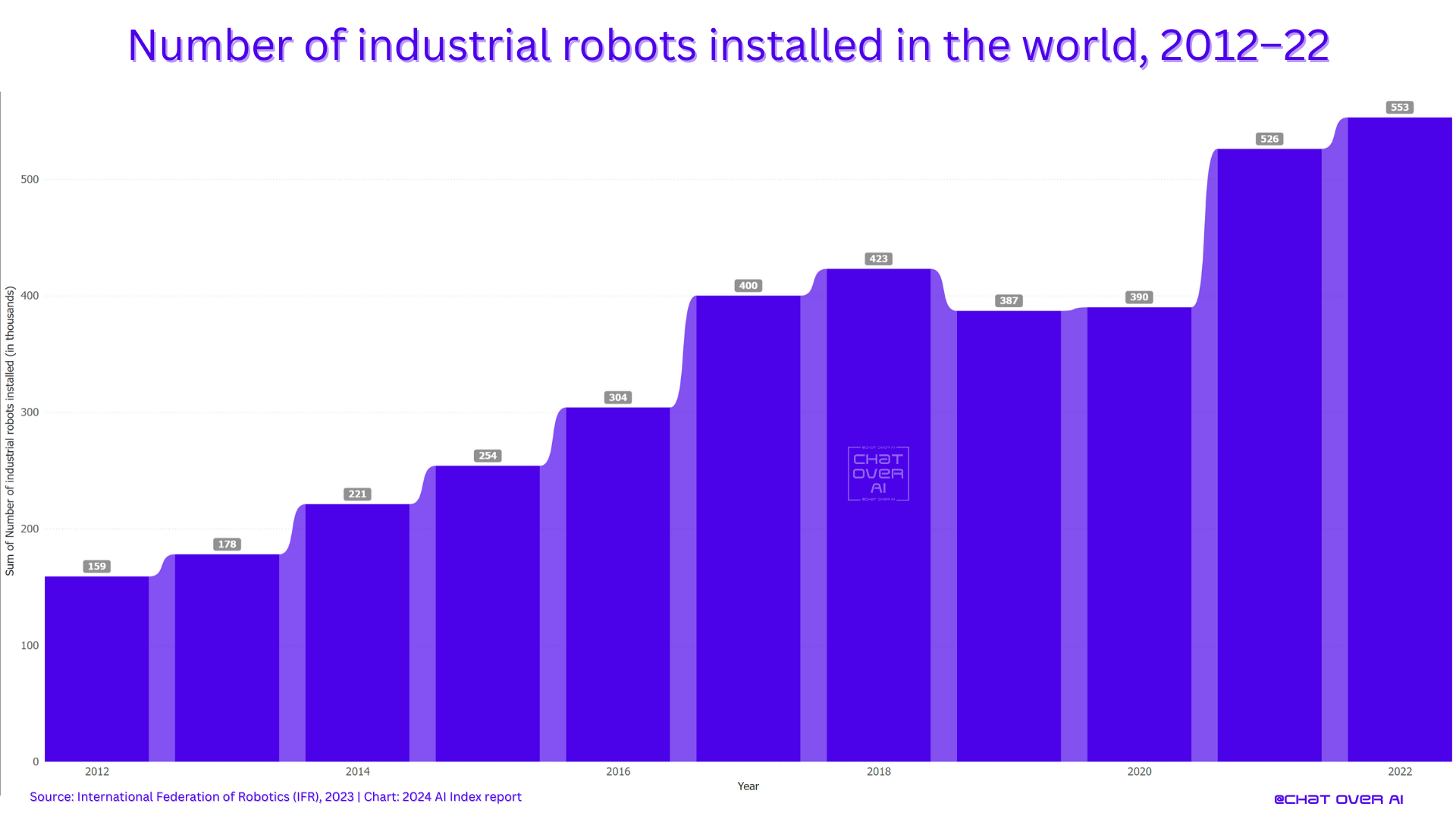
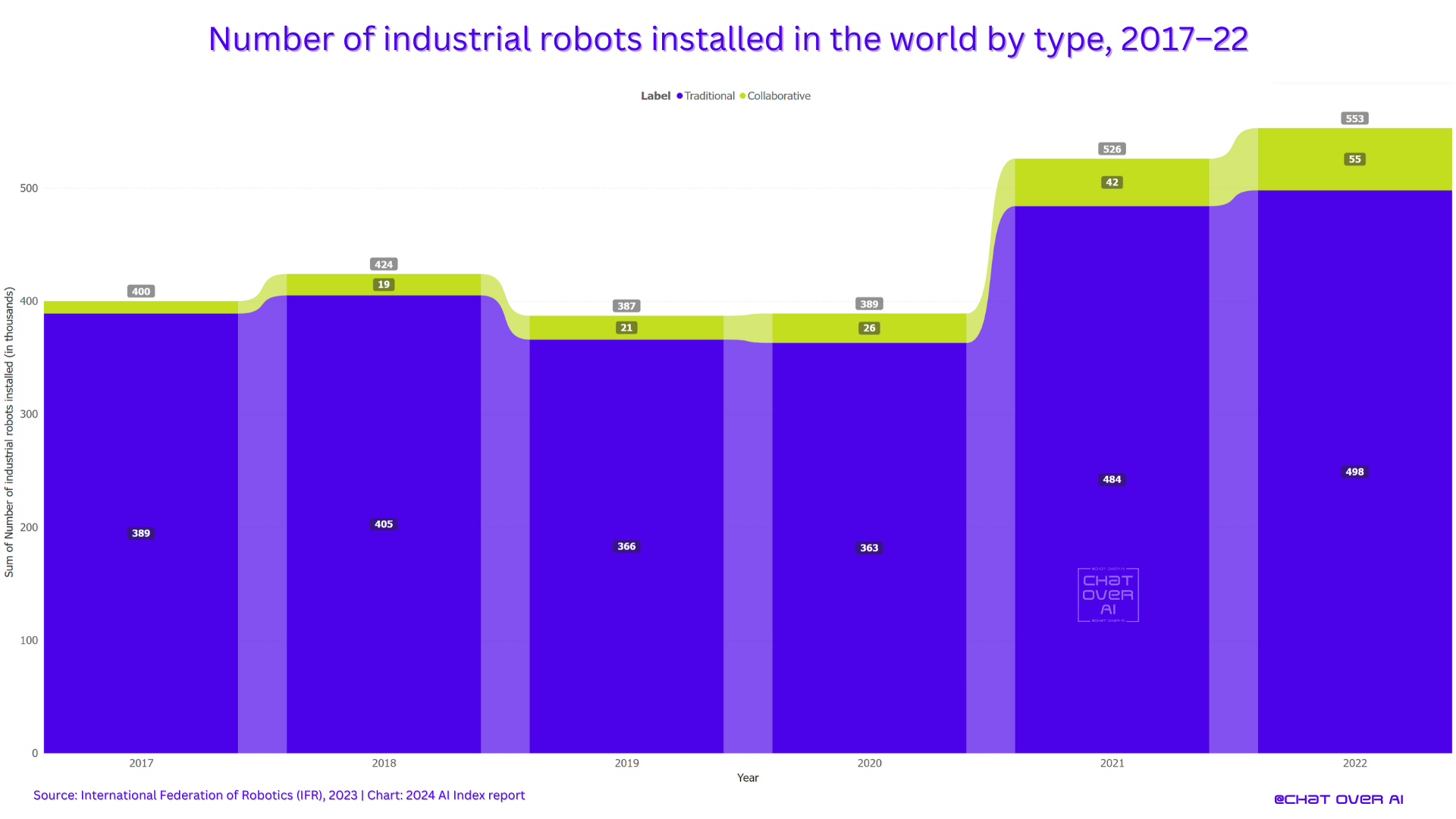
According to the 2024 AI Index Report, industrial robots are on the rise, but they're evolving into something a bit cuddlier (metaphorically speaking, of course). In 2022, industrial robot installations reached 553,000 units, marking a 5.1% increase from 2021. This growth reflects more than a threefold rise in installations since 2012. Collaborative robots—or "cobots"—are becoming the new office heroes, assisting with work rather than stealing it. Cobots accounted for 9.9% of all new robot installations in 2022, which is up from just 2.8% in 2017. So, they're growing fast—like rabbits, if rabbits were made of metal and took on warehouse shifts.
The Global Stockpile: Robots Are Everywhere
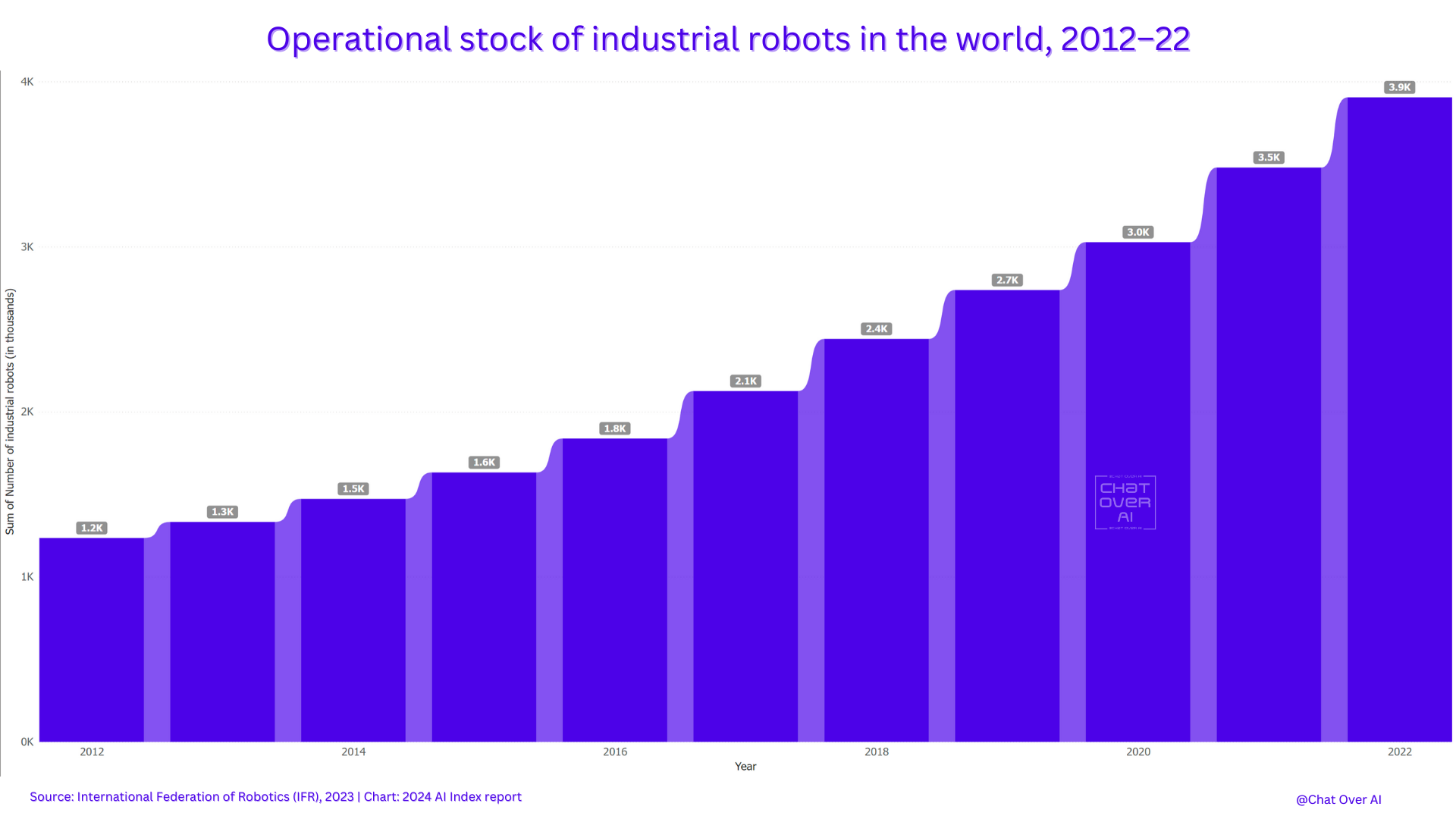
The global operational stock of industrial robots reached 3,904,000 units in 2022, up from 3,479,000 in 2021. Over the past decade, both the installation and utilization of industrial robots have steadily increased. Imagine it like a worldwide game of “collect them all,” except instead of Pokémon, it’s robots, and instead of battling, they’re assembling car parts and making your favorite sneakers.
Cobots: The New Office MVPs
Why are cobots trending, you ask? Simple: humans are lazy. Well, not exactly lazy—more like smartly lazy. You know, why do the dishes when you have a dishwasher? Why fetch the ball when you have a very eager golden retriever? Cobots are like that—except they don't shed, slobber, or chase squirrels. Instead, they take care of the mundane, repetitive stuff, so humans can focus on more “important” activities, like deciding whether to order caramel or vanilla lattes or debating if pineapple belongs on pizza.
The distinction between traditional robots and collaborative robots is crucial here. Traditional robots work in isolation, often caged away to avoid accidental collisions with their human counterparts. Cobots, however, are designed to work alongside us—sharing workspace, handing over tools, and maybe even offering a metaphorical high-five when a job is well done. The robotics community loves cobots for their safety, flexibility, scalability, and ability to learn iteratively.
China, by the way, is way ahead in this game. In 2023, they accounted for over 52.4% of global robot installations. While China is racing ahead, other countries are still figuring out how to attach a robot arm to the coffee machine. It’s like an Olympic race where China is a rocket and everyone else is just happy to remember their sneakers.
The Dynamic Duo: Humans and Robots
Now, here’s where things get interesting. Instead of fighting robots for our jobs (nobody wants to lose to a metal arm named Steve), humans and robots are making a pretty good tag team. Imagine this: you're at work, and the robot does all the lifting, sorting, and generally boring stuff, while you get to do the exciting parts—like “strategizing” (a.k.a. watching cat videos until inspiration hits).
A recent McKinsey survey showed that 42% of organizations experienced cost reductions thanks to automation, and 59% saw revenue increases. In other words, companies are saving money and making more money because robots are out there, being the ultimate reliable coworkers—they never call in sick, and they certainly never steal your lunch from the breakroom fridge. If robots had feelings, they'd probably be rolling their digital eyes at our human antics, muttering "I just do my job, Karen."
Cobots on the Rise: By the Numbers
Let's talk more about those cobots. In 2017, collaborative robots accounted for just 2.8% of all new industrial robot installations. Fast forward to 2022, and cobots made up 9.9% of all new installations. This impressive growth showcases the enthusiasm within the robotics community for cobots due to their safety, flexibility, scalability, and ability to learn iteratively. Cobots are no longer the new kids on the block—they're becoming essential co-workers who thrive on team spirit. They’ve earned their place beside us, handing us the proverbial wrench while we brainstorm our next big idea.
The Human Touch: Collaborative Benefits
Cobots aren't just about doing the work faster—they're about doing it better. With more than 3.9 million operational robots in play globally, we're seeing a surge in how robots are being integrated into workplaces to enhance productivity without replacing the human touch. This collaborative spirit is one of the key reasons why companies are opting for cobots—they're safe, adaptable, and can learn on the go. Imagine a world where your robot assistant not only hands you tools but also learns the sequence of tasks just by observing you. That’s not science fiction anymore—that’s today’s factory floor reality.
Should We Fear the Rise of the Machines?
Only if you’re in a line of work that involves endless repetition. You know, tasks that a robot can do with their eyes closed (if they had eyes, and if they could close). Stack boxes, drive screws, or stand very still for hours—those jobs are at risk. But even then, the robots aren’t here to take the whole job—they're just here to take the boring bits. The truth is, robots free up humans to focus on the fun parts of work—the thinking, the creating, the complaining about how the printer is still, after all these years, broken.
As for the economic impact? China is installing robots faster than you can say "automation revolution," but we’re all still safe for now. Most of the robots are either too busy doing assembly line gymnastics or figuring out how to balance on one wheel without tipping over. If anything, the rise of robotics is less a march towards a dystopian future and more like a very organized dance of productivity improvements.
Conclusion: Embrace Your New Robot Buddy
In short, robots aren’t our overlords—they’re our overly diligent, unpaid interns. They’re the ones who'll hold that door open for you indefinitely, pick up the 100th screw without sighing, and vacuum under the bed without grumbling about all the dust bunnies. So, next time you hear "robots are taking over," don’t picture a world ruled by metallic overlords. Picture a world where robots are taking care of the boring bits, while you’re free to binge-watch your favorite series in peace. Sounds like a win-win to me.
Thanks for reading Chat Over AI! Subscribe for free to receive new posts and support my work.