


Artificial Intelligence (AI) is not just about self-driving cars and robots taking over the world—it's about the skills that bring those visions to life. In 2023, the demand for generative AI skills has skyrocketed, and we've got the data to prove it. Here’s a breakdown of the most sought-after generative AI skills that employers are hunting for in the United States.
Thanks for reading Chat’s Substack! Subscribe for free to receive new posts and support my work.
Generative AI: The New Superstar
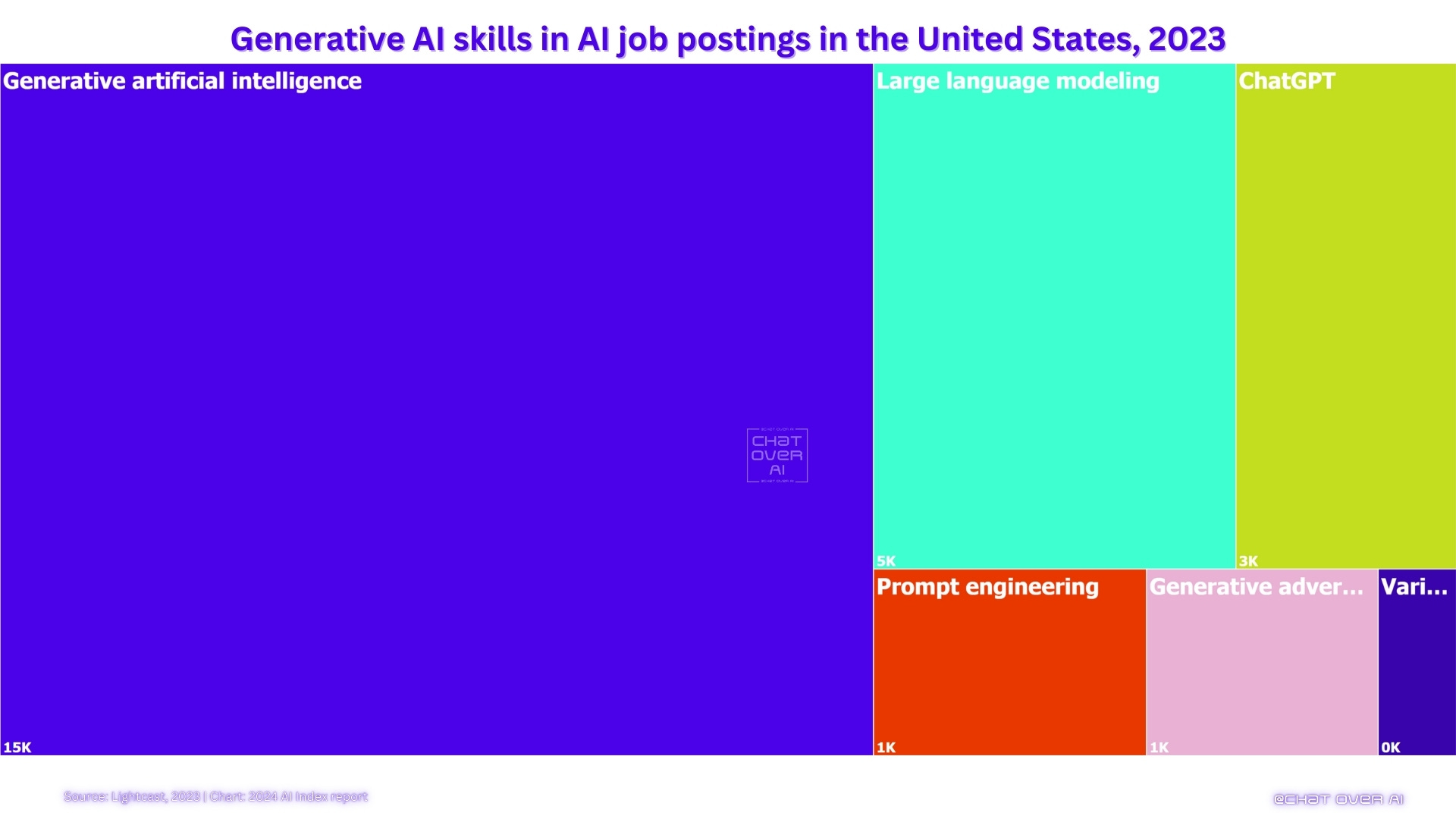
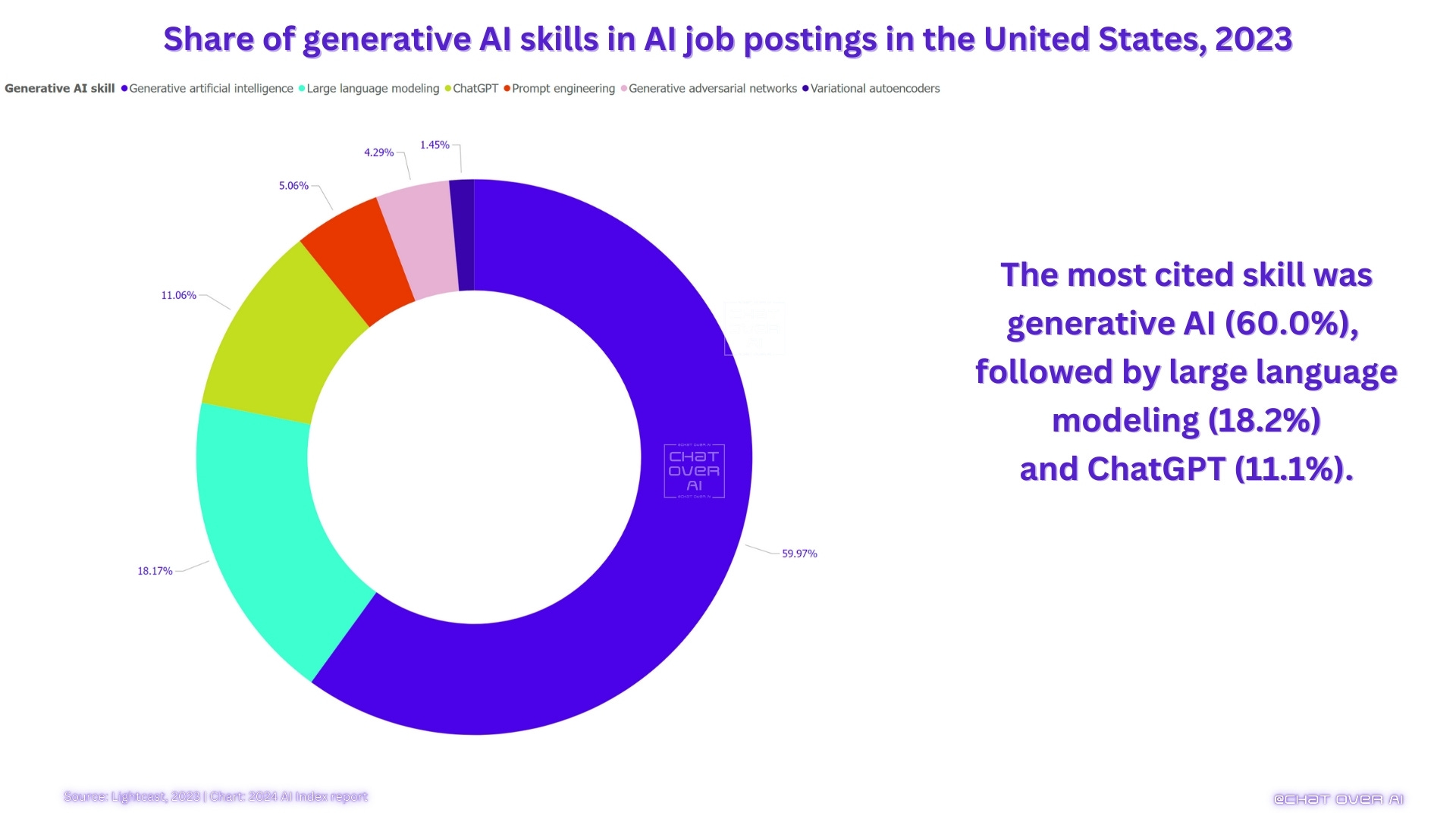
When it comes to generative AI skills, one skill stands tall above the rest—Generative Artificial Intelligence. With 15,000 job postings mentioning it, this skill is the undisputed heavyweight champion of the generative AI world. Employers are looking for experts who can build AI models that do more than just analyze—they create. From writing articles to generating images, generative AI has become the darling of the industry. (It’s kind of like AI’s version of that one friend who’s good at everything—they make the rest of us look bad, but we also secretly want to be them.)
Large Language Models and ChatGPT: Riding the Wave
Large language modeling comes in second with 5,000 job postings, highlighting the demand for AI systems that can understand and generate human-like text. Whether it's chatbots, language translation, or writing assistance, large language models are everywhere. (And let's be honest—who wouldn't want an AI that can help write those awkward “we need to talk” emails?)
Not far behind is ChatGPT, with 3,000 job postings. This conversational AI tool has taken the world by storm, and it turns out employers love it too. Companies are eager to leverage conversational AI to improve customer service, streamline business processes, and make life just a little bit easier for their customers. (Plus, it's always nice to have a chatbot that doesn't need coffee breaks or vacation days.)
Prompt Engineering: The Art of Talking to AI
Coming in at 1,000 job postings is Prompt Engineering—basically, the skill of knowing how to talk to an AI to get the best results. Think of it as being the AI whisperer. You need to know what to ask and how to ask it to get AI to do what you want. (Because let’s be real, if you've ever tried to get an AI to answer a question and ended up with a recipe for banana bread instead, you know it’s a skill worth having.)
Honorable Mentions: GANs and Variational Autoencoders
Generative Adversarial Networks (GANs) and Variational Autoencoders (VAEs) also make the list, albeit with fewer mentions. GANs are used for generating realistic images, while VAEs are used for data compression and representation learning. They may not have as many postings, but they play a crucial role in the AI landscape. (GANs are kind of like the AI version of an art competition—two neural networks go head-to-head, and the result is a masterpiece.)
Thanks for reading Chat’s Substack! Subscribe for free to receive new posts and support my work.
Key Takeaways for Aspiring AI Professionals
The generative AI field is booming, and if you want a slice of the action, now is the time to hone those skills. Generative AI, large language modeling, and prompt engineering are the skills that will get you noticed in 2023. Whether you want to teach an AI to paint like Picasso, generate insightful text, or just figure out how to get ChatGPT to answer your questions correctly on the first try—these are the skills that will make you an AI superstar.
Conclusion
The demand for generative AI skills is growing faster than you can say "machine learning." Companies are on the lookout for individuals who can not only build AI models but also use them to generate creative and functional outputs. So, if you’re interested in becoming a part of this AI revolution, it's time to add these skills to your resume. (And remember, prompt engineering is more than just typing into a chatbox—it's about knowing the secret password to unlock the AI's full potential. Think of it like being the AI’s best friend—without all the drama!)