


If AI were a popularity contest, the United States would be crowned prom king every single year. The AI investment landscape is anything but evenly distributed, and some countries have been throwing more cash at AI than others. Let's dive into the latest numbers and see which regions are investing big, which are scaling back, and who might be gearing up for a comeback. Spoiler: Uncle Sam is on top.
Private Investment in AI by Geographic Area in 2023
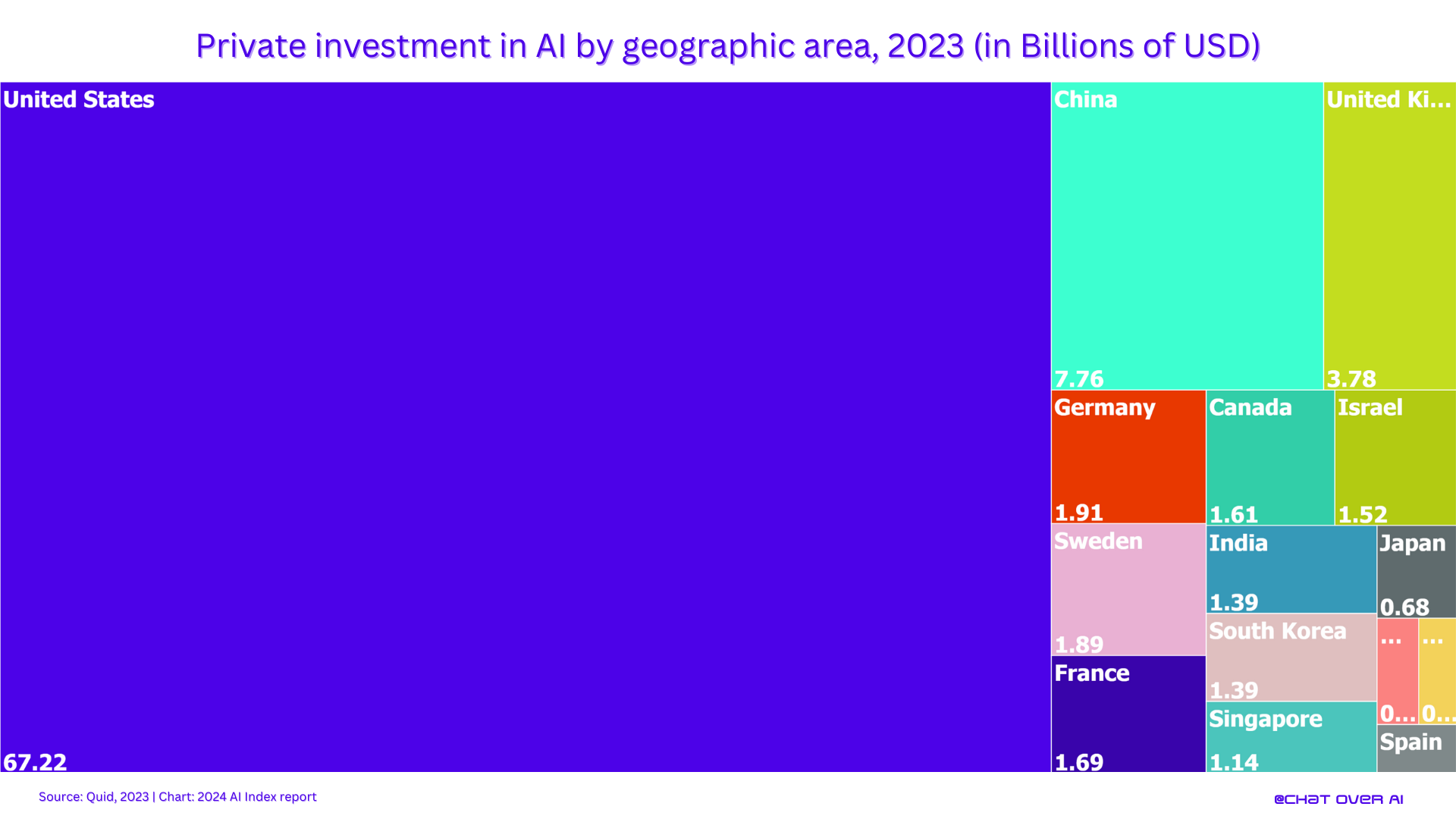
Let’s kick things off with a look at 2023. The United States is leading the pack with a whopping $67.22 billion in private AI investments. It’s safe to say the U.S. is treating AI like its favorite grandchild—it can’t stop giving and giving. Far behind but still notable is China, with $7.76 billion invested. The United Kingdom came in next with $3.78 billion, while countries like Germany ($1.91 billion) and Canada ($1.61 billion) are trying their best to keep up but could use a little caffeine boost.
Thanks for reading Chat Over AI! Subscribe for free to receive new posts and support my work.
Israel and India made notable appearances with $1.52 billion and $1.39 billion, respectively. For a country the size of Israel, that’s like David throwing a lot of cash at Goliath—talk about punching above your weight! Meanwhile, Japan, France, and Sweden round out the field with more modest investments. While it might seem like everyone is investing, the chart makes one thing clear: the U.S. is truly in a league of its own.
A Bird's Eye View: Regional Investment Map of 2023
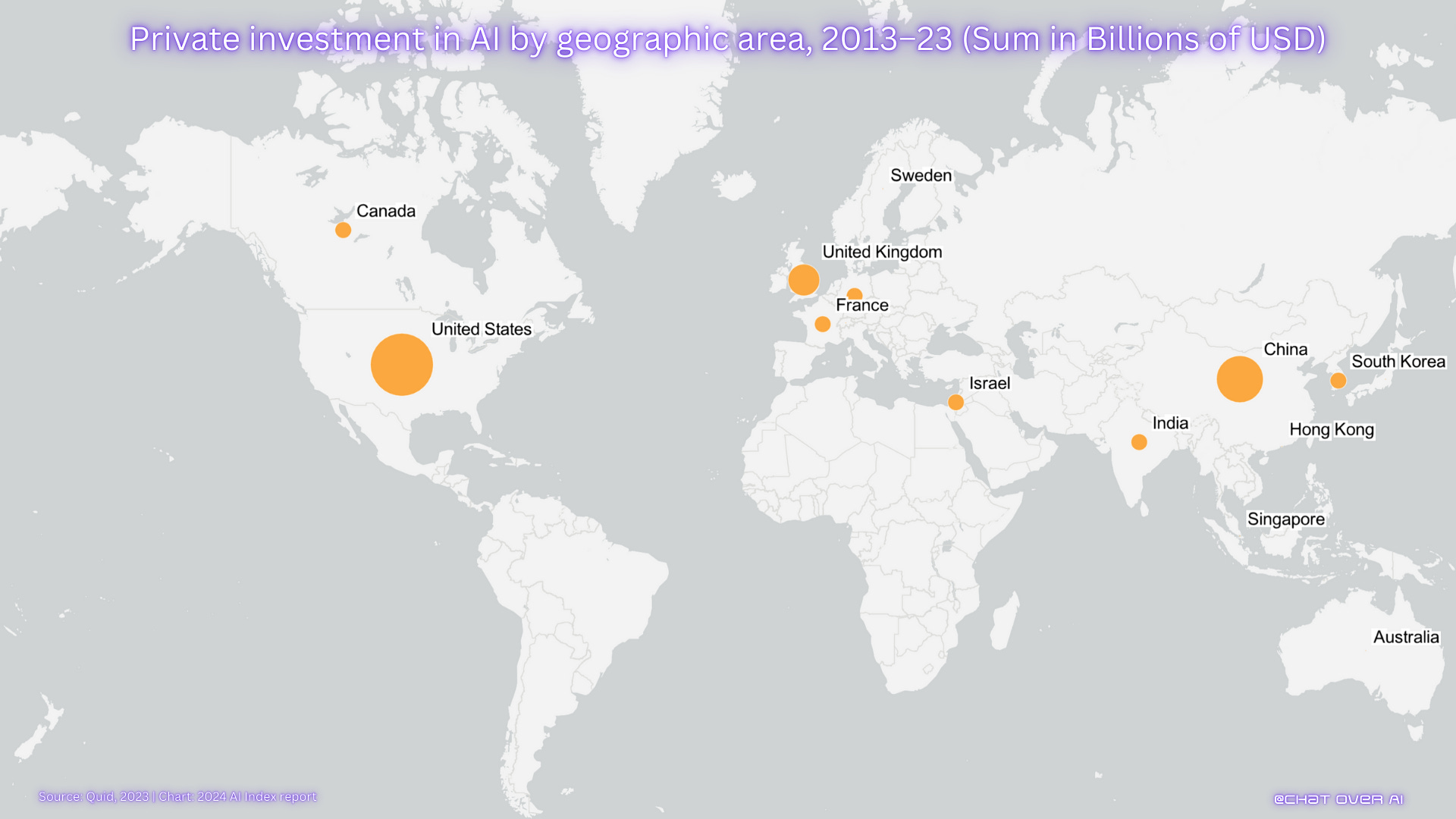
Chart 2 provides a global heatmap of private AI investment in 2023. The United States stands out as a giant, glowing orange spot on the map—something like a bright neon sign screaming, “We love AI!” Other countries, like China and the United Kingdom, make their presence known, but it's the U.S. that really steals the show.
Canada and Germany show up as smaller but still significant dots, while India and Israel have their fair share of orange as well. It’s interesting to see that while the U.S. dominates, there's still a broad interest in AI investments across multiple continents. But, as the map tells us, when it comes to private funding, the size of the investment really does matter—and the U.S. is leading by a wide margin.

A Decade of AI Investment: Who’s Been Spending the Most?
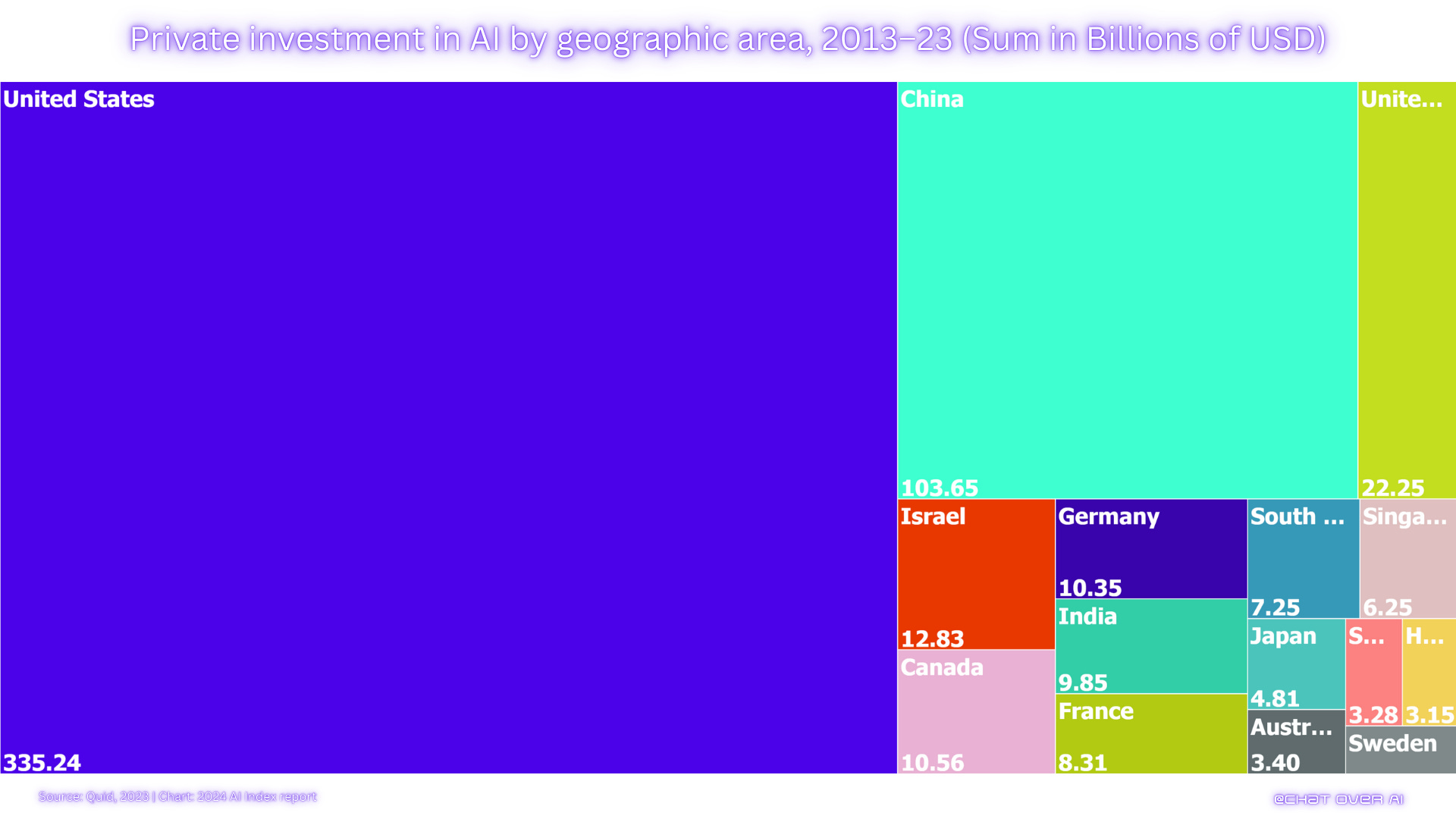
Looking back over the decade from 2013 to 2023, we get an even clearer picture of the global AI investment hierarchy. The United States tops the charts again with $335.2 billion invested, followed by China with $103.7 billion. That’s a sizable gap—like comparing a mountain to a molehill, if the molehill was still impressively large.
The United Kingdom comes in third with $22.3 billion invested, showing that they’re not out of the game but definitely trailing behind the two giants. Israel, Germany, and Canada are also on the list, contributing smaller but significant amounts to AI’s growing ecosystem. It’s like everyone wants a piece of the AI pie, but the U.S. has been eating slice after slice while others look for a fork.
The Growing Gap: U.S. vs. the Rest of the World
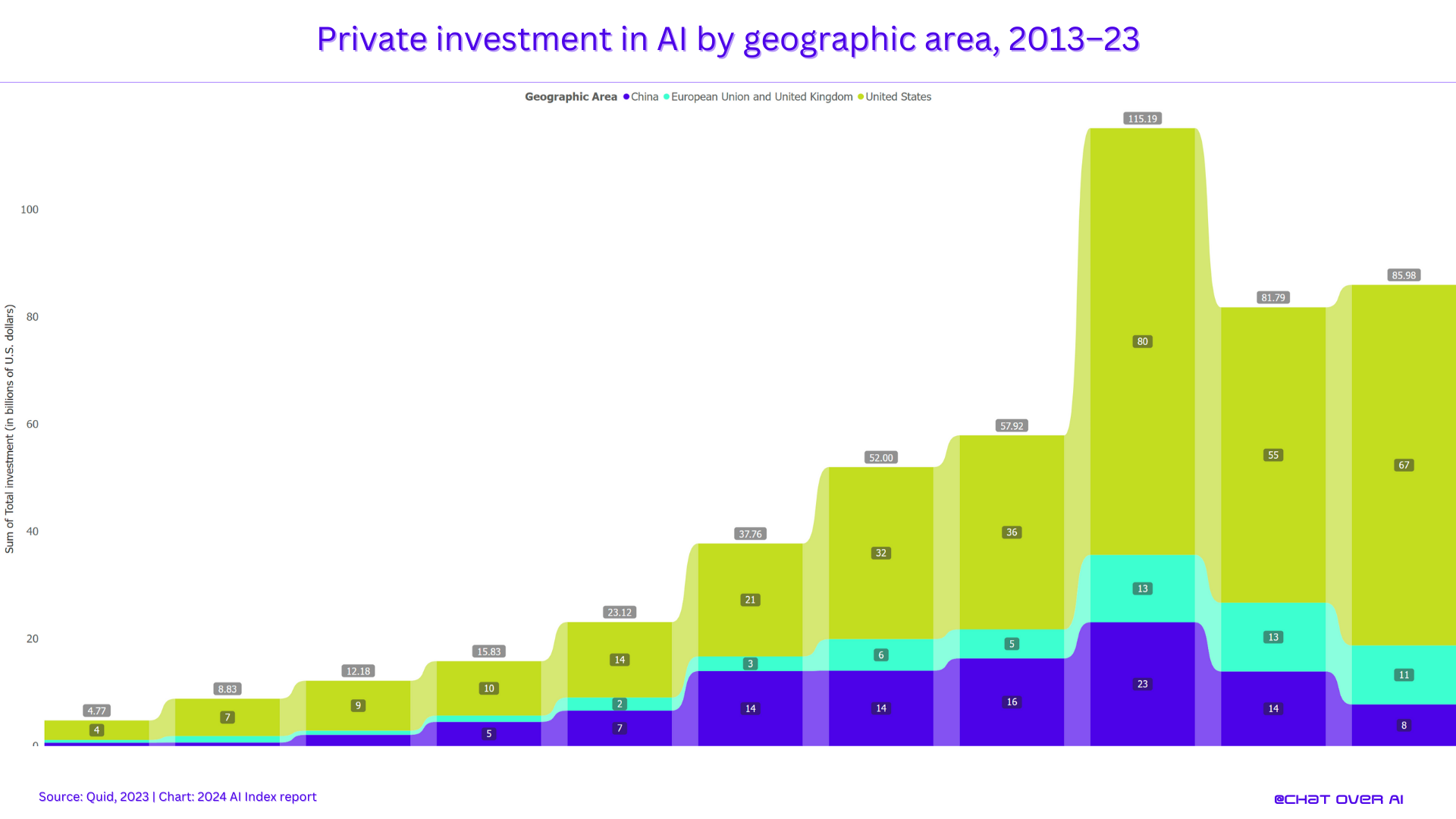
Finally, Chart 5 shows how the gap in private AI investments between the United States and other regions is widening over time. While investments in China dropped by 44.2% and those in the European Union and United Kingdom fell by 14.1% since 2022, the U.S. has seen a solid 22.1% increase during the same period. It’s like the U.S. got a second wind, while everyone else is catching their breath.
Even as private AI investments in many other regions take a step back, the United States is charging full steam ahead. This trend suggests that the U.S. isn’t just leading; it’s actively pulling away from the rest of the world in terms of private AI investment. If AI development is a race, the U.S. just shifted into turbo mode.
What Does It All Mean?
The AI investment landscape is increasingly dominated by a few key players, with the United States clearly in the lead. Despite some downturns globally, the U.S. continues to attract major private investment into AI. This isn’t just about dollars; it’s about influence, control over future technologies, and ensuring that the next big thing comes out of Silicon Valley—or, at least, somewhere on American soil.
Meanwhile, countries like China, Israel, and the United Kingdom aren’t giving up, but they are facing a growing challenge in matching the sheer scale of U.S. investments. While some regions pull back, new generative AI startups are receiving increased funding, with 99 new startups funded in 2023, compared to 56 in 2022. It seems there’s still no shortage of new ideas and optimism for what AI can do.
Conclusion: The U.S. Leads, but the Race Isn't Over
The numbers make one thing crystal clear: the United States has a huge lead in private AI investment, and it’s widening that gap. But as AI continues to evolve, it’s not just about how much money you throw at the problem—it’s also about how you use it. Countries like China and Israel are still in the race, and who knows? Maybe the next big AI breakthrough will come from a country that’s currently just a small orange dot on the map.
Until then, the U.S. is cruising ahead, with deep pockets and big ambitions, making it the undisputed leader of the AI investment game. The rest of the world? Well, they better buckle up and start investing—or risk being left in the digital dust.
Thanks for reading Chat Over AI! Subscribe for free to receive new posts and support my work.